
The Power of Compounding: How Time Grows Your Wealth
Learn how compound growth, consistent contributions, and time can transform modest investments into substantial long-term wealth.

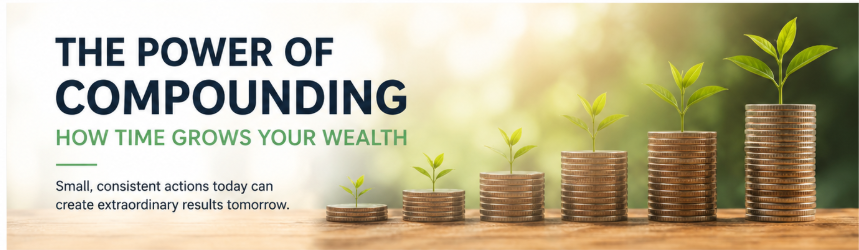
Building wealth is often presented as a search for the next exceptional investment. In practice, one of the most powerful forces is much less dramatic: earning returns on earlier returns over a long period of time.
This process is known as compounding.
Compounding does not eliminate investment risk, and it does not guarantee a specific result. What it does is allow time, reinvestment, and consistent contributions to work together. The longer the process continues, the larger the potential effect becomes.
What is compound growth?
Suppose you invest $10,000 and earn a 7% return during the first year.
At the end of the year, the investment is worth:
$10,000 × 1.07 = $10,700
During the second year, the return is earned on the full $10,700—not only on the original $10,000.
After another 7% return:
$10,700 × 1.07 = $11,449
The additional $749 earned in the second year consists of:
- $700 earned on the original investment
- $49 earned on the previous year’s return
That extra $49 is the beginning of compounding. It looks small at first, but the effect becomes progressively larger because each year’s gains can generate additional gains.
The basic compound-growth formula is:
Future value = Initial investment × (1 + annual return)ⁿ
Here, n represents the number of years.
Why compounding appears slow at first
Compound growth is not linear.
With linear growth, the same amount is added during every period. With compound growth, the amount added can increase because the investment base becomes larger.
For example, assume an initial investment of $10,000 earns an average annual return of 7%:
| Time invested | Approximate value |
|---|---|
| 10 years | $19,672 |
| 20 years | $38,697 |
| 30 years | $76,123 |
| 40 years | $149,745 |
The first ten years add approximately $9,672.
The final ten years—from year 30 to year 40—add approximately $73,622.
Nothing changed in the assumed return. The difference is that, in later years, the return is being earned on a much larger amount.
This is why compounding often feels unimpressive at the beginning and powerful near the end.
Time can matter more than the starting amount
A person who begins investing early may contribute less money overall and still finish with more than someone who starts much later.
Consider two hypothetical investors.
Investor A: starts early
Investor A invests $5,000 at the end of every year for 20 years, starting at age 25. After age 44, no additional contributions are made, but the money remains invested until age 65.
Total contributions:
$5,000 × 20 = $100,000
Investor B: starts later
Investor B waits until age 45 and then invests $5,000 at the end of every year for 20 years.
Total contributions:
$5,000 × 20 = $100,000
Both investors contribute the same amount. However, Investor A’s earliest contributions have as much as 40 years to grow, while Investor B’s earliest contribution has only 20 years.
Under the same return assumptions, Investor A would generally finish with substantially more.
The lesson is not that starting late is pointless. The lesson is that unused time cannot be recovered by investment skill alone. A later start may require larger contributions, a longer working period, a lower future spending target, or some combination of the three.
Consistent contributions amplify compounding
Compounding becomes especially powerful when it is combined with regular contributions.
Assume someone invests $500 each month and earns an average annual return of 7%, compounded monthly.
| Time invested | Total contributions | Approximate portfolio value |
|---|---|---|
| 10 years | $60,000 | $86,542 |
| 20 years | $120,000 | $260,463 |
| 30 years | $180,000 | $609,986 |
| 40 years | $240,000 | $1,312,407 |
After 40 years, the investor contributed $240,000, while the hypothetical portfolio grew to more than $1.3 million.
Most of the ending value came from investment growth rather than contributions.
This example is illustrative. Actual returns will vary, and taxes, fees, inflation, and market volatility can materially change the result.
The rate of return matters—but so do fees
Small differences in annual return can create large differences over long periods.
A $10,000 investment compounded for 40 years would grow approximately to:
| Average annual return | Approximate value after 40 years |
|---|---|
| 4% | $48,010 |
| 6% | $102,857 |
| 7% | $149,745 |
| 8% | $217,245 |
| 10% | $452,593 |
This does not mean investors should automatically pursue the highest possible return. Higher expected returns normally involve greater uncertainty and larger potential losses.
It does show why unnecessary fees matter.
A portfolio earning 7% before costs but losing 1.5% annually to fees effectively compounds at roughly 5.5% before taxes. Over several decades, that difference can become substantial.
Relevant costs may include:
- Fund expense ratios
- Advisory fees
- Trading costs
- Currency-conversion fees
- Account charges
- Taxes caused by frequent selling
An investment does not need to have the lowest possible cost, but its costs should be justified by the value it provides.
Compounding also works against you
Compounding is not automatically beneficial. It magnifies whichever process is allowed to continue.
High-interest debt is a clear example.
If credit-card interest is added to an unpaid balance, future interest may be charged on both the original debt and earlier interest. In this case, compounding increases the borrower’s liability rather than wealth.
The same principle applies to recurring financial mistakes:
- Excessive fees
- Unnecessary taxes
- Persistent overspending
- High-interest borrowing
- Repeatedly selling after market declines
- Leaving long-term savings uninvested without a reason
Compounding rewards good habits, but it can also punish bad ones.
Market returns do not arrive smoothly
Examples of compounding often use a constant annual return, but real markets do not behave that way.
A portfolio might gain 20% in one year, lose 15% in another, and remain nearly unchanged in a third. The long-term average can still be positive, but the path is uncertain.
Losses also have an asymmetric effect:
- A 10% loss requires an 11.1% gain to recover.
- A 25% loss requires a 33.3% gain.
- A 50% loss requires a 100% gain.
This is one reason risk management matters. An investment strategy must be capable of surviving difficult periods long enough for compounding to operate.
The highest theoretical return is not useful if the investor abandons the strategy during a severe drawdown.
Inflation reduces purchasing power
A future portfolio value should not be confused with future purchasing power.
If an investment grows by 7% annually while inflation averages 3%, the approximate real return is closer to 4% before taxes and fees.
For example, receiving $1 million several decades from now will not provide the same purchasing power as $1 million today.
Long-term planning should therefore distinguish between:
- Nominal returns: growth measured in future currency
- Real returns: growth after accounting for inflation
Real returns provide a more realistic picture of how much future consumption an investment may support.
Taxes can interrupt compounding
Taxes reduce the amount that remains invested.
In an account where gains are taxed every time an investment is sold, frequent trading can create a recurring tax drag. In contrast, deferring taxes allows more capital to remain invested and potentially continue compounding.
The exact tax treatment depends on the investor’s country, account type, asset, and personal circumstances.
This is one reason investors should consider not only what they earn, but also:
- When taxes become payable
- Whether gains are realized or unrealized
- Whether dividends are taxed
- Whether tax-advantaged accounts are available
- Whether unnecessary turnover can be reduced
Tax efficiency should not override investment quality, but it can materially influence long-term results.
Five ways to make compounding work more effectively
1. Start with what you can
Waiting until you can invest a large amount may sacrifice valuable time. A smaller contribution made consistently can be more useful than a larger contribution that is repeatedly postponed.
2. Automate contributions
Automatic monthly investing reduces the need to make a fresh decision every month. It also helps maintain consistency during both strong and weak markets.
3. Reinvest income
Reinvesting dividends, distributions, and interest allows investment income to purchase additional assets that may generate future income.
4. Control avoidable costs
Fees, taxes, and unnecessary trading reduce the capital available to compound.
5. Choose a strategy you can maintain
A portfolio should match the investor’s financial position, time horizon, and tolerance for losses. Compounding requires remaining invested through periods when markets are uncomfortable.
The biggest advantage is often behavioral
The mathematics of compounding is simple. Following it for decades is not.
Investors face recurring temptations to:
- Chase recent winners
- Abandon investments after losses
- Wait indefinitely for the perfect entry point
- Take excessive risk to accelerate results
- Constantly replace a reasonable plan with a new one
Long-term wealth often depends less on finding a perfect investment and more on avoiding decisions that repeatedly interrupt the process.
Patience is not passive. It is the discipline to continue following a sound plan when short-term results are uncertain.
Final thoughts
Compounding combines three ingredients:
Capital × Return × Time
Investors have limited control over future market returns. They have more control over when they begin, how consistently they contribute, how much they pay in costs, and whether they remain invested.
The early years may feel slow because contributions are doing most of the work. Over time, the balance can shift. Investment growth may eventually become larger than the amount being added.
That transition is where compounding becomes especially powerful.
The central principle is simple:
The best time to begin was earlier. The next-best time is when a sustainable plan can be started and maintained.
This article is provided for educational and informational purposes only and does not constitute personalized financial or investment advice. The examples use hypothetical returns and exclude some taxes, fees, and other costs. Actual investment results will vary.